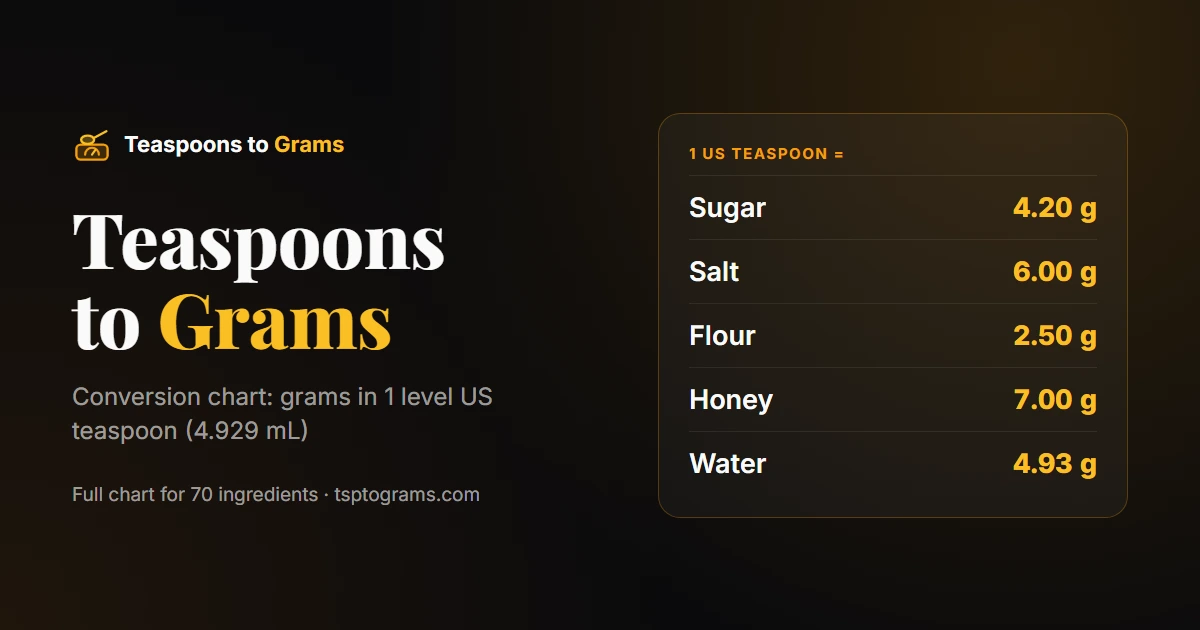
Quick answer: One teaspoon (tsp) equals 4.20 grams (g) of granulated sugar, 6.00 g of table salt, 2.50 g of all-purpose flour, 7.00 g of honey, and 4.93 g of water. No single number covers every ingredient. Teaspoons measure volume, grams measure weight, and density sets the gram weight for each ingredient.
A teaspoons to grams conversion turns a volume measurement into a weight measurement through one factor: ingredient density. The conversion gives a cook 3 gains: recipes from any country work with local measuring spoons, nutrition labels written in grams become spoon amounts, and small ingredient amounts stay accurate without a kitchen scale. This guide has 4 parts: a calculator, a chart of common sugar amounts, quick answers for 5 ingredient groups, and a printable one-page chart.
Teaspoons to Grams Calculator
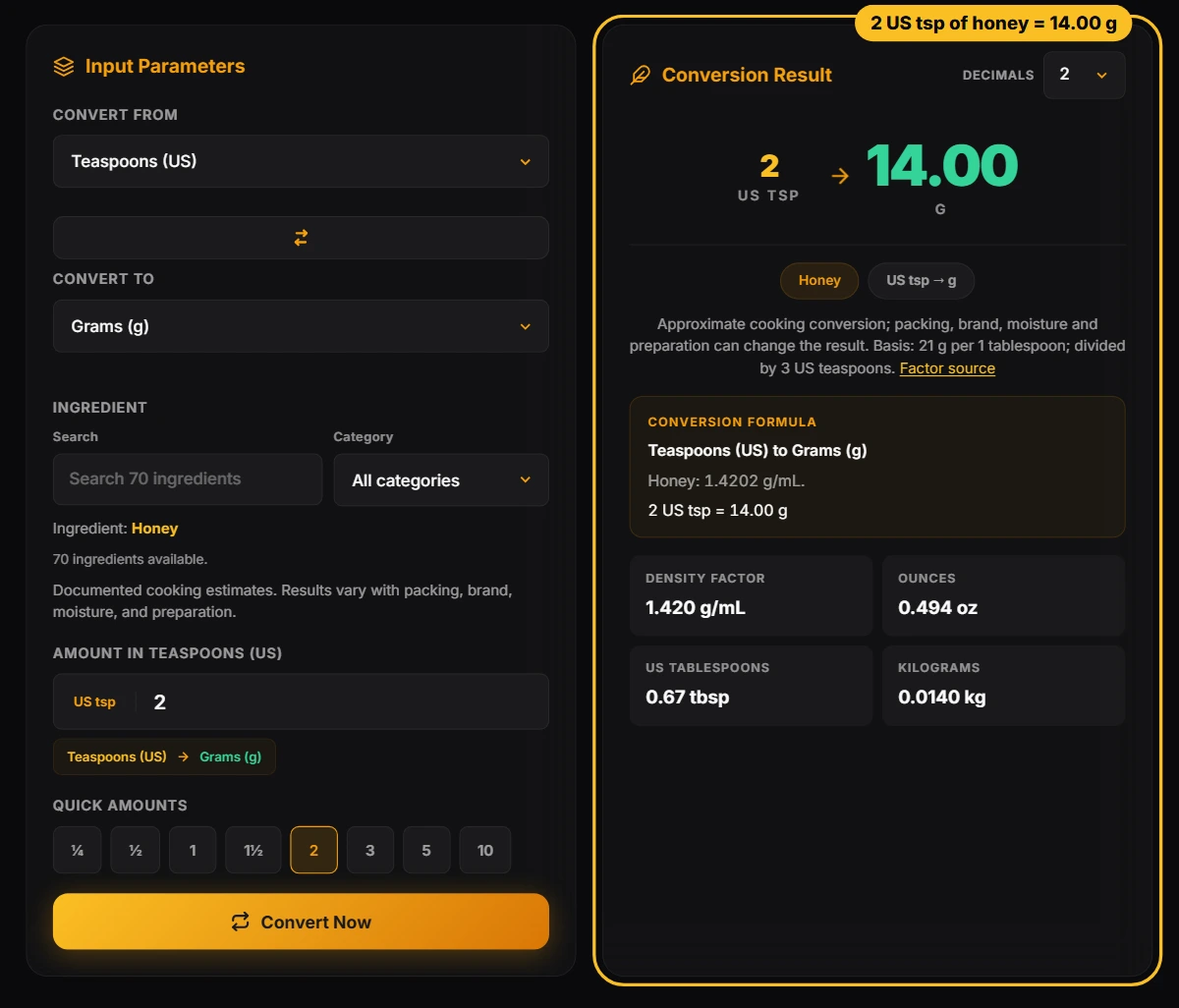
To convert teaspoons to grams with the homepage calculator, complete 3 steps:
- Select the ingredient from the dropdown.
- Enter the teaspoon amount.
- Read the gram result.
The calculator applies the density of the selected ingredient and supports 3 teaspoon standards: US (4.929 mL), metric (5 mL), and historical Imperial (5.919 mL). A generic converter applies the water ratio to every ingredient. The water ratio returns a wrong weight for flour, honey, and salt.
Convert any amount now with the tsptograms calculator.
Common Sugar Amounts in Grams
The chart lists granulated sugar first because nutrition labels state sugar in grams, so sugar is the conversion cooks need most often when reading a label.
| Teaspoons | Grams of granulated sugar |
|---|---|
| ¼ tsp | 1.05 g |
| ½ tsp | 2.10 g |
| 1 tsp | 4.20 g |
| 2 tsp | 8.40 g |
| 3 tsp | 12.60 g |
| 5 tsp | 21.00 g |
| 10 tsp | 42.00 g |
Ten teaspoons of granulated sugar weigh 42.00 g (1.48 oz). The same 10 teaspoons weigh 25.00 g for all-purpose flour and 70.00 g for honey. The ingredient changes the result, and the full chart below gives the gram weight for 70 ingredients.
Full Ingredient Conversion Chart
The full chart covers 70 ingredients in 5 groups: Sugars and sweeteners, Flours and baking, Fats and oils, Milk and cream, and Other ingredients. Every value uses a level teaspoon and is an approximate cooking estimate; the measurement guide explains the sources and assumptions.
Sugars & sweeteners
| Ingredient | 1 US tsp | 1 metric tsp |
|---|---|---|
| Granulated white sugar | 4.20 g | 4.26 g |
| Agave syrup | 7.00 g | 7.10 g |
| Brown sugar (packed) | 4.44 g | 4.50 g |
| Coconut sugar | 3.21 g | 3.25 g |
| Corn syrup | 6.50 g | 6.59 g |
| Demerara sugar | 4.58 g | 4.65 g |
| Honey | 7.00 g | 7.10 g |
| Jam or preserves | 7.08 g | 7.19 g |
| Maple sugar | 3.25 g | 3.30 g |
| Maple syrup | 6.50 g | 6.59 g |
| Molasses | 7.08 g | 7.19 g |
| Confectioners' sugar (unsifted) | 2.35 g | 2.39 g |
| Turbinado sugar (raw) | 3.75 g | 3.80 g |
Flours & baking
| Ingredient | 1 US tsp | 1 metric tsp |
|---|---|---|
| All-purpose flour | 2.50 g | 2.54 g |
| Almond flour | 2.00 g | 2.03 g |
| Bread flour | 2.50 g | 2.54 g |
| Unbleached cake flour | 2.50 g | 2.54 g |
| Coconut flour | 2.67 g | 2.71 g |
| Gluten-Free All-Purpose Flour (King Arthur) | 3.25 g | 3.30 g |
| Pastry flour | 2.21 g | 2.24 g |
| Whole wheat flour (King Arthur Premium 100%) | 2.35 g | 2.39 g |
| Double-acting baking powder | 4.00 g | 4.06 g |
| Baking soda | 6.00 g | 6.09 g |
| Cornstarch | 2.33 g | 2.37 g |
| Unsweetened cocoa powder | 1.75 g | 1.78 g |
| Active dry yeast | 3.10 g | 3.14 g |
| Instant yeast | 3.11 g | 3.16 g |
| Breadcrumbs (dried) | 2.33 g | 2.37 g |
| Oats (old-fashioned or quick-cooking) | 1.85 g | 1.88 g |
| White rice flour | 2.96 g | 3.00 g |
| Tapioca starch | 2.35 g | 2.39 g |
Fats & oils
| Ingredient | 1 US tsp | 1 metric tsp |
|---|---|---|
| Butter | 4.71 g | 4.78 g |
| Coconut oil | 4.71 g | 4.78 g |
| Ghee | 3.67 g | 3.72 g |
| Lard | 4.71 g | 4.78 g |
| Olive oil | 4.17 g | 4.23 g |
| Palm shortening | 3.75 g | 3.80 g |
| Vegetable oil (King Arthur chart estimate) | 4.13 g | 4.18 g |
Milk & cream
| Ingredient | 1 US tsp | 1 metric tsp |
|---|---|---|
| Buttermilk | 4.73 g | 4.80 g |
| Coconut milk (canned, shaken) | 5.02 g | 5.09 g |
| Sweetened condensed milk | 6.50 g | 6.59 g |
| Cottage cheese | 4.71 g | 4.78 g |
| Cream cheese | 4.73 g | 4.80 g |
| Evaporated milk | 4.71 g | 4.78 g |
| Heavy or whipping cream | 4.73 g | 4.80 g |
| Mascarpone cheese | 4.73 g | 4.80 g |
| Milk (King Arthur chart value) | 4.73 g | 4.80 g |
| Nonfat milk powder | 2.33 g | 2.37 g |
| Sour cream | 4.73 g | 4.80 g |
| Yogurt | 4.73 g | 4.80 g |
Other ingredients
| Ingredient | 1 US tsp | 1 metric tsp |
|---|---|---|
| Water | 4.93 g | 5.00 g |
| Chia seeds | 3.08 g | 3.13 g |
| Espresso powder | 2.33 g | 2.37 g |
| Fine table salt | 6.00 g | 6.09 g |
| Kosher salt (Diamond Crystal) | 2.67 g | 2.71 g |
| Kosher salt (Morton's) | 5.33 g | 5.41 g |
| Flaxseed | 2.92 g | 2.96 g |
| Garlic (minced) | 4.67 g | 4.73 g |
| Lemon juice | 4.67 g | 4.73 g |
| Matcha powder | 2.00 g | 2.03 g |
| Garlic powder (fine) | 3.10 g | 3.14 g |
| Ground cinnamon | 2.60 g | 2.64 g |
| Mayonnaise | 4.71 g | 4.78 g |
| Hazelnut spread | 6.67 g | 6.76 g |
| Peanut butter | 5.63 g | 5.71 g |
| Poppy seeds | 3.00 g | 3.04 g |
| Sesame seeds | 2.96 g | 3.00 g |
| Tahini paste | 5.33 g | 5.41 g |
| Tomato paste | 4.83 g | 4.90 g |
| Vanilla extract | 4.67 g | 4.73 g |
Why the Conversion Is Not a Fixed Ratio
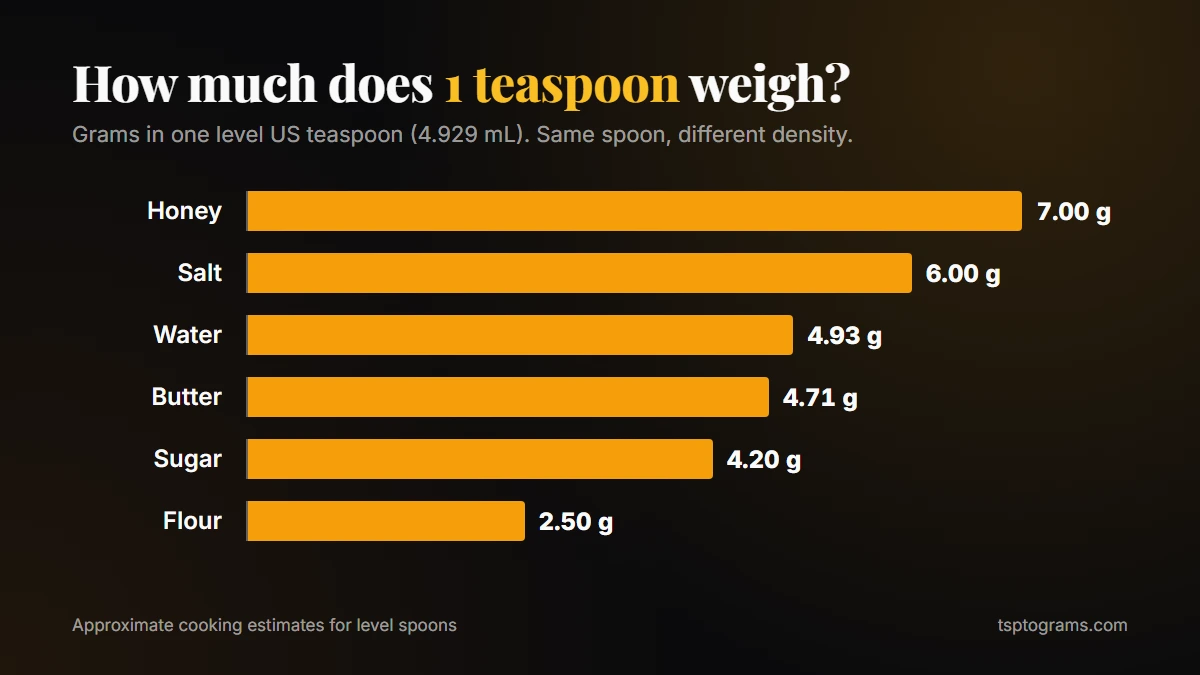
Teaspoons to grams has no fixed ratio because a teaspoon measures volume and a gram measures mass. Density (g/mL) connects volume and mass. One US teaspoon holds about 4.929 mL of any ingredient, and the density of the ingredient decides the weight of that volume.
A teaspoon of feathers weighs far less than a teaspoon of sand. The spoon holds the same volume in both cases, and the material inside the spoon sets the weight. Kitchen ingredients follow the same rule. All-purpose flour has a density near 0.51 g/mL, granulated sugar near 0.85 g/mL, table salt near 1.22 g/mL, and honey near 1.42 g/mL. Water sits at about 1.00 g/mL.
The formula states the relationship in one line:
grams = teaspoons × grams per teaspoonTwo teaspoons of honey weigh 14.00 g because one US teaspoon of honey weighs 7.00 g and 2 × 7.00 = 14.00. Two teaspoons of all-purpose flour weigh 5.00 g because one US teaspoon of flour weighs 2.50 g. The values on this page come from USDA MyPyramid Equivalents Database 2.0, King Arthur Baking Ingredient Weight Chart, Red Star Yeast: Common Yeast Baking Questions, USGS Water Science School: Water density, and USDA National Nutrient Database for Standard Reference, Release 28: Spices and Herbs. They are approximate cooking estimates: packing, brand, moisture and particle size all move the real weight.
Ingredient Quick Answers
Sugar
One teaspoon of granulated sugar weighs 4.20 g. Brown sugar is measured packed and weighs 4.44 g per teaspoon. A cook converting a nutrition label divides the grams by 4.20: 5 g of sugar equals 1.19 teaspoons. Other amounts are on the sugar converter page.
→ Sugar conversions in the full chart
Salt
One teaspoon of fine table salt weighs 6.00 g. Kosher salt depends on the brand: Diamond Crystal weighs 2.67 g per teaspoon and Morton weighs 5.33 g, because the two brands' crystals differ in shape and size, so different amounts fit in the spoon. A recipe calling for 5 g of table salt needs 0.83 teaspoons. The salt converter page lists more amounts.
→ Salt conversions in the full chart
Baking Powder, Baking Soda, and Yeast
One teaspoon of baking powder weighs 4.00 g, one teaspoon of baking soda weighs 6.00 g, and one teaspoon of active dry yeast weighs 3.10 g. A recipe calling for 5 g of baking powder needs 1.25 teaspoons. Single-ingredient pages cover baking powder and yeast in detail.
→ Baking conversions in the full chart
Honey, Oil, and Liquids
One teaspoon of honey weighs 7.00 g, one teaspoon of vegetable oil weighs 4.13 g, and one teaspoon of water weighs 4.93 g. Honey is about 1.42 times as dense as water, so the same spoon holds more grams. A jar label stating 15 g of honey equals 2.14 teaspoons.
→ Liquid conversions in the full chart
Matcha and Espresso Powder
One teaspoon of matcha powder weighs 2.00 g. Espresso powder weighs 2.33 g per teaspoon. A 5 g serving of matcha equals 2.50 teaspoons.
→ Matcha and powder conversions in the full chart
US vs Metric vs Historical Imperial Teaspoons
Three teaspoon sizes appear in recipes, and each holds a different volume:
| Standard | Volume |
|---|---|
| US teaspoon | 4.929 mL |
| Metric teaspoon | 5.000 mL |
| Historical Imperial teaspoon | 5.919 mL |
The US and metric teaspoons differ by 1.4%. The historical Imperial teaspoon holds 20% more volume than a US teaspoon and appears in older British recipes. It is not a current standard: the 5.919 mL figure is derived from the Imperial fluid ounce, and published sizes for the old British teaspoon conflict, so treat Imperial results as approximate. Modern UK, Australian, and European recipes use the 5 mL metric teaspoon.
Granulated sugar shows the practical effect of the 3 sizes:
| Amount | US tsp | Metric tsp | Historical Imperial tsp |
|---|---|---|---|
| 1 teaspoon of sugar | 4.20 g | 4.26 g | 5.04 g |
| 5 teaspoons of sugar | 21.00 g | 21.30 g | 25.22 g |
The converter on this site recalculates every result for the selected teaspoon standard. Changing the standard changes the math, not only the label.
Printable Conversion Chart
The printable chart fits all 70 ingredients on one letter-sized page. Print the chart, keep the chart beside the measuring spoons, and read any teaspoon amount in grams without opening a phone. The chart lists US and metric values side by side and groups the ingredients under the same 5 groups as the full chart.
Download the free printable chart (PDF, 1 page)
Frequently Asked Questions
How many grams are in one teaspoon?
One teaspoon holds 4.20 g of sugar, 6.00 g of table salt, 2.50 g of flour, 7.00 g of honey, and 4.93 g of water. The ingredient decides the number because a teaspoon measures volume and each ingredient packs a different mass into the same volume. State the ingredient, and the conversion has one answer.
Why does the conversion change for every ingredient?
Density changes the conversion for every ingredient. A gram measures mass and a teaspoon measures volume, and density states the mass inside one millilitre. Flour sits near 0.51 g/mL and honey sits near 1.42 g/mL, so one teaspoon of honey weighs 2.8 times one teaspoon of flour. No density value means no valid conversion.
How many grams is 2 teaspoons of sugar?
2 teaspoons of granulated sugar weigh 8.40 g. One US teaspoon of granulated sugar weighs 4.20 g, and 2 × 4.20 = 8.40. Packed brown sugar weighs more per spoon: 2 teaspoons of packed brown sugar weigh 8.88 g. Unsifted confectioners' sugar weighs less: 2 teaspoons weigh 4.71 g.
Is 1 teaspoon always 5 grams?
No. One teaspoon equals about 5.00 grams only for water in a metric teaspoon. Water in a US teaspoon weighs 4.93 g. All-purpose flour weighs 2.50 g per US teaspoon, and honey weighs 7.00 g per US teaspoon. The 5-gram rule works as a rough shortcut for water-like liquids and fails for dry ingredients.
How do I convert teaspoons to grams without a kitchen scale?
Use the ingredient chart and a level measuring spoon. Find the ingredient in the chart, multiply the teaspoon amount by the gram value, and level each spoon with a knife for a consistent fill. Or try the calculator: it performs the same multiplication instantly and covers amounts the chart rows skip.
What is the difference between a US and a metric teaspoon?
A US teaspoon holds 4.929 mL and a metric teaspoon holds 5.000 mL. The metric teaspoon is 1.4% larger. The difference adds 0.06 g to a teaspoon of sugar and 0.30 g to 5 teaspoons of sugar. Precise baking recipes reward the correct standard, and everyday cooking tolerates the difference.
Key Takeaways
- Use the conversion chart for a fast answer: one teaspoon equals 4.20 g of sugar, 6.00 g of salt, 2.50 g of flour, and 7.00 g of honey.
- Use the online calculator for a precise answer: select the ingredient, enter the amount, and read the gram result for US, metric, and historical Imperial teaspoons.
- Trust density over shortcuts: density sets every conversion, and the 5-gram rule covers water in a metric teaspoon alone.
Bookmark this chart or print the chart. A recipe mixing grams and teaspoons stops costing extra minutes at the counter.