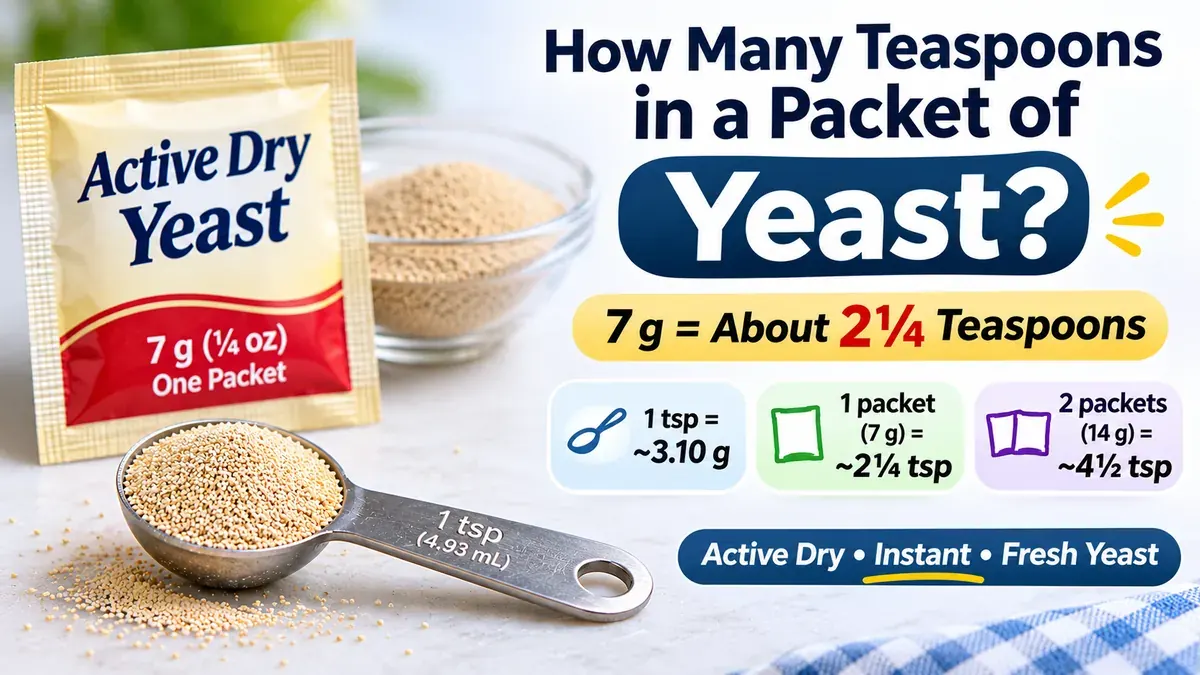
If a bread recipe calls for one packet of yeast, you'll usually need about 2¼ level US teaspoons of active dry yeast. That's the amount in a standard 7-gram (¼-ounce) packet.
You don't need to buy individual packets every time you bake. If you keep yeast in a bulk jar, you can scoop out approximately the same amount with a measuring spoon. Just make sure you're using active dry yeast and check the package weight, since packet sizes can vary.
Below, we'll look at the teaspoon-to-gram conversion, why volume and weight don't match perfectly, and how to measure yeast properly.
Teaspoons and Grams in a Standard Packet
A standard 7-gram packet of active dry yeast contains about 2¼ level US teaspoons. If your recipe calls for one packet but you have a jar instead, measure out roughly the same amount with a measuring spoon.
Based on the active dry yeast conversion on TspToGrams, one level US teaspoon weighs approximately 3.10 grams. That puts 2¼ teaspoons at about 6.98 grams, very close to the 7 grams listed on a standard packet.
| Measurement (US teaspoons) | Weight |
|---|---|
| ¼ teaspoon | 0.78 g |
| 1 teaspoon | 3.10 g |
| 2 teaspoons | 6.20 g |
| 2¼ teaspoons (1 packet) | 6.98 g |
| 4½ teaspoons (2 packets) | 13.95 g |
Making a recipe that calls for two standard packets? Use about 4½ teaspoons, or 14 grams. Check the package label before measuring, though. Not every yeast packet contains 7 grams.
US vs. Metric Teaspoons
The measurements above use US teaspoons, which hold about 4.93 mL. A metric teaspoon holds 5 mL. For active dry yeast, one level metric teaspoon weighs approximately 3.14 grams.
Why Isn't the Packet Math Exact?
You may notice that 2¼ teaspoons of yeast doesn't add up to exactly 7 grams. There's a simple reason: teaspoons measure volume (space), while grams measure weight (mass). The amount in a spoon can vary slightly depending on how the granules settle and how you fill and level it.
Using our reference value of 3.10 grams per level US teaspoon, the calculation is:
2.25 × 3.10 = 6.975 gramsRounded to two decimal places, that's 6.98 grams. The difference from a 7-gram packet is only 0.025 grams, which is unlikely to make a noticeable difference in everyday bread baking.
You might occasionally see 6.97 grams on another converter. That can happen when the result is truncated (the extra decimal places are cut off) instead of rounded to the nearest hundredth.
For most home recipes, 2¼ level teaspoons is a practical substitute for one standard 7-gram packet. If your recipe calls for a more precise weight, use a digital kitchen scale and follow the weight specified in the recipe or on the package.
Active Dry vs. Instant vs. Fresh Yeast
The three common types of baker's yeast do the same job, but they aren't identical. Active dry and instant yeast come in dry granules, while fresh yeast is soft and moist. The type you have affects how you prepare it and, in some recipes, how much you need.
Active Dry Yeast
Active dry yeast has relatively coarse granules and is commonly sold in packets or jars. Many traditional recipes ask you to dissolve it in warm water before adding it to the dough. This helps rehydrate the granules, although some products can also be mixed directly with flour.
A standard 7-gram packet contains approximately 2¼ level US teaspoons. The conversion figures in this article are specifically for active dry yeast.
Instant Yeast
Instant yeast has finer granules and can usually go straight into the flour without being dissolved first. It often gets the dough rising sooner, so keep an eye on the dough rather than relying only on a fixed rising time.
For traditional home-baking recipes, Red Star allows instant and active dry yeast to be substituted in equal amounts. That means you can generally use 2¼ teaspoons of instant yeast in place of 2¼ teaspoons of active dry yeast. Bread-machine recipes can have different requirements, so follow the machine and yeast manufacturer's instructions.
Fresh Yeast (Cake or Compressed Yeast)
Fresh yeast is soft, moist, and usually sold in refrigerated blocks. You can crumble it into the flour or dissolve it in liquid, depending on the recipe and package directions.
Don't use the dry-yeast teaspoon conversion for fresh yeast. Its moisture content and texture make it a different ingredient to measure. Use a kitchen scale and a fresh-to-dry yeast conversion when substituting it.
Cake sizes also vary by manufacturer. For example, Fleischmann's says its small 0.6-ounce fresh yeast cake is equivalent to one packet of dry yeast. That's a brand-specific package comparison, not a rule for every fresh yeast cake.
Which Type Should You Use?
The easiest option is to use the yeast listed in your recipe. If you only have instant yeast instead of active dry, an equal-amount swap generally works in traditional dough recipes. You can usually skip the dissolving step with instant yeast.
If you're using fresh yeast instead, check a reliable conversion for the exact amount you need and weigh it rather than measuring it by teaspoons.
Important: The teaspoon-to-gram figures elsewhere in this article apply only to active dry yeast. Use the separate yeast entry in the converter for instant yeast, and don't apply either dry-yeast value to fresh cake yeast.
How to Measure Yeast from a Packet or a Jar
If you bake often, keeping yeast in a jar is handy. You can measure out what you need instead of opening a new packet each time. The trick is to keep the granules loose and level the spoon rather than packing it full.
For one standard 7-gram packet of active dry yeast, measure 2¼ level US teaspoons.
Step-by-Step Measuring Guide
- Use a dry measuring spoon. Make sure it's clean and dry before measuring.
- Spoon, don't scoop. Use a smaller spoon to transfer yeast from the jar into your measuring spoon. Pushing the measuring spoon into the jar can compact the granules.
- Level the top. Sweep the flat edge of a knife across the spoon. Don't press the yeast down or leave a heap on top.
- Measure what the recipe calls for. Half of a standard packet is about 1⅛ teaspoons. If your packet has a different weight, use its label as your guide.
Measuring Small Amounts of Yeast
Some recipes call for just ¼ teaspoon of yeast. Based on the TspToGrams converter, that amount of active dry yeast weighs approximately 0.78 grams.
A kitchen scale that reads in 0.1-gram increments can help with small amounts. A scale that only displays whole grams may round such a small quantity to 0 or 1 gram, making measuring spoons a more practical choice.
How to Test Yeast That's Been Open for a While
An opened jar of yeast can lose activity over time, especially if it is exposed to moisture or heat. If you're unsure whether it's still working, you can test it before adding it to your dough.
Red Star provides one method for testing dry yeast:
- Dissolve 1 teaspoon of sugar in ½ cup of warm water (110°F–115°F).
- Stir in 2¼ teaspoons of dry yeast.
- Wait 10 minutes.
According to Red Star, an active mixture should rise to the 1-cup mark and have a rounded, foamy top. If it passes, use it right away and reduce the liquid in your recipe by ½ cup. If it doesn't reach that mark, Red Star advises discarding the yeast.
Other brands may use different amounts of water, temperatures, or signs of activity, so check their instructions before testing.
Frequently Asked Questions
Are 2 teaspoons of yeast the same as one packet?
No. Two level US teaspoons weigh about 6.20 grams, compared with 7 grams in a standard packet. Add another ¼ teaspoon (about 0.78 grams) to get approximately 6.98 grams.
Can I substitute instant yeast for active dry yeast?
In many traditional bread recipes, you can use instant yeast in the same amount as active dry yeast. For example, 2¼ teaspoons of instant yeast can replace one standard packet of active dry yeast. Instant yeast can usually be mixed directly into the flour without dissolving it first. Check the product instructions for specific recipes.
Can I use these measurements for fresh yeast?
No. Fresh yeast contains more moisture than dry yeast, so the same teaspoon-to-gram conversion does not apply. Use a fresh-to-dry yeast conversion and weigh it when possible.
How many teaspoons are in two packets of yeast?
Two standard 7-gram packets of active dry yeast contain approximately 4½ level US teaspoons, or 14 grams in total.
How should I store an opened jar of yeast?
Close the lid tightly after each use and keep moisture out of the jar. Many dry yeast products should be refrigerated after opening, but storage instructions and recommended storage times vary. Check the package for the manufacturer's guidance.
Can I use yeast after its expiration date?
It may still be active, but yeast can lose its rising power over time. If you're unsure, test it before using it, as described above, or follow the testing instructions for your own brand.
Conclusion
A standard 7-gram packet of active dry yeast contains about 2¼ level US teaspoons. If your recipe calls for one packet and you have a jar instead, measuring out 2¼ teaspoons gives you approximately the same amount.
The small difference between spoon volume and packet weight is unlikely to matter in everyday home baking. If your recipe specifies an exact weight, use a digital kitchen scale for a more precise measurement.
Keep in mind that these conversions are for active dry yeast. Instant and fresh yeast have different characteristics, so check their specific measurements before making a substitution.