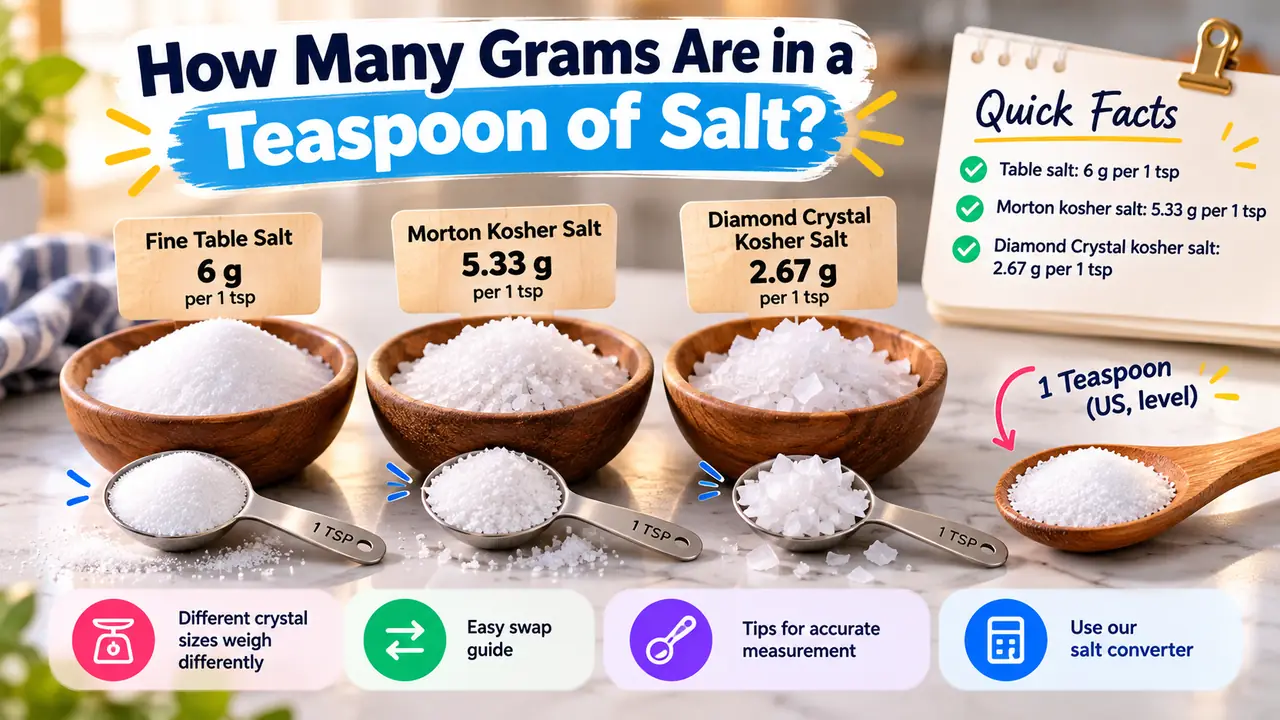
A level US teaspoon of fine table salt weighs about 6 grams, while the same spoon of Morton kosher salt weighs around 5.33 grams and Diamond Crystal kosher salt about 2.67 grams.
Why such a big difference? Salt crystals vary in size and shape, so they pack differently in a measuring spoon.
If you're following a recipe or swapping one type of salt for another, knowing these differences can help you measure accurately and avoid making your food too salty.
Below, we'll compare common salt types, show their weights in grams, and explain how to substitute them.
How Many Grams in a Teaspoon of Salt?
The weight of a teaspoon of salt depends on the type you use. Here are the approximate weights for one level US teaspoon:
| Type of salt | Weight per level US teaspoon |
|---|---|
| Fine table salt | 6 g |
| Morton kosher salt | 5.33 g |
| Diamond Crystal kosher salt | 2.67 g |
Source: King Arthur Baking ingredient weight chart (per tablespoon, divided by 3).
These numbers apply to a level measuring spoon. If you heap salt above the rim or pack it down, the weight can change.
A 5 mL metric teaspoon of fine table salt weighs approximately 6.09 grams, compared with 6 grams for a US teaspoon.
For other quantities, use our salt teaspoon-to-grams converter.
Quick Salt Conversion Table
The following table shows approximate weights for common US teaspoon measurements.
| US teaspoons | Fine table salt | Morton kosher salt | Diamond Crystal kosher salt |
|---|---|---|---|
| ¼ tsp | 1.50 g | 1.33 g | 0.67 g |
| ½ tsp | 3.00 g | 2.67 g | 1.33 g |
| 1 tsp | 6.00 g | 5.33 g | 2.67 g |
| 2 tsp | 12.00 g | 10.67 g | 5.33 g |
| 3 tsp | 18.00 g | 16.00 g | 8.00 g |
These values are calculated from the approximate grams-per-teaspoon figures above. Actual measurements may vary with crystal size, packing, and measuring technique.
For example, if your recipe calls for half a teaspoon of fine table salt, that is about 3 grams. But half a teaspoon of Diamond Crystal kosher salt is only about 1.33 grams.
This is why measuring salt by volume can produce different results when you change brands or types.
Why Does the Same Spoon Hold Different Weights?
A teaspoon measures volume, not weight. The amount of salt it holds depends on the size and shape of the crystals and how closely they fit together.
Fine table salt has small crystals that pack relatively tightly. Larger kosher salt crystals can leave more space between them.
As a result, two level teaspoons can hold the same volume but contain different weights of salt.
How Crystal Size and Shape Affect Weight
Consider the three salt types in the table:
- Fine table salt: Small, closely packed crystals give it a relatively high weight per teaspoon.
- Morton kosher salt: Its crystal structure produces a lower weight per teaspoon than fine table salt.
- Diamond Crystal kosher salt: Its larger, lighter crystal structure gives it a much lower weight per teaspoon.
The difference is not simply whether the salt looks coarse or fine. Crystal shape, density, and the spaces between crystals also affect how much fits into a spoon.
The same principle applies to other ingredients, including flour, sugar, and butter.
Learn more in our guide to why teaspoons weigh differently.
How to Swap One Salt for Another
If a recipe calls for one type of salt and you only have another, the amounts may need to change.
Fine table salt weighs more per teaspoon than Diamond Crystal kosher salt. Swapping them spoon for spoon can change the amount of salt in your recipe.
Using the approximate weights above, here are some practical substitutions.
| Recipe calls for | Approximate replacement |
|---|---|
| 1 tsp Diamond Crystal kosher salt | ½ tsp table salt |
| 1 tsp Morton kosher salt | ⅞ tsp table salt |
| 1 tsp table salt | 2¼ tsp Diamond Crystal kosher salt |
| 1 tsp table salt | 1⅛ tsp Morton kosher salt |
Why These Salt Swaps Are Approximate
These substitutions are rounded to practical measuring-spoon amounts.
For example, 1 teaspoon of Diamond Crystal kosher salt weighs about 2.67 grams. Half a teaspoon of table salt weighs about 3 grams.
That makes the replacement convenient, but not identical by weight.
Similarly, replacing 1 teaspoon of table salt with 2¼ teaspoons of Diamond Crystal gives approximately 6.00 grams based on the listed conversion values.
For everyday cooking, these swaps can be helpful starting points. Taste and adjust when appropriate.
For brines, curing, or recipes that require precise salt concentrations, use the required weight in grams rather than rounded spoon substitutions. Do not rely on approximate volume swaps for food-safety-critical curing instructions.
How to Measure Salt with a Teaspoon
For a consistent measurement, use a standard US measuring teaspoon rather than an ordinary eating spoon.
Fill the spoon without deliberately pressing down the salt, then level the top with a straight edge.
1. Use a Level Measuring Spoon
A heaped teaspoon holds more salt than a level teaspoon.
Run the straight edge of a knife across the top to remove the excess.
2. Avoid Packing the Salt
Pressing or compacting salt can change how much fits into the spoon.
Fill it gently and use a consistent technique.
3. Use a Kitchen Scale for Precision
A kitchen scale measures weight directly, so you do not need to account for differences in crystal size when following a recipe given in grams.
However, very small quantities can be difficult to measure accurately on some household scales.
For example, ¼ teaspoon of table salt is only about 1.50 grams. A scale with suitable precision is helpful when measuring small amounts.
For everyday cooking, a level spoon is often convenient. For baking or recipes that require precise amounts, weighing salt can give more consistent results.
See our measurement guide for more information about converting teaspoons and grams.
Is It Better to Measure Salt in Grams or Teaspoons?
Both methods have their place.
Measuring teaspoons are convenient for everyday cooking, especially when a recipe specifies the salt type.
Grams are more useful when you need to compare different salt types or follow a recipe that requires a specific weight.
For example, 6 grams of fine table salt and 6 grams of Diamond Crystal kosher salt have the same mass, even though they occupy different volumes.
If a recipe gives salt in grams, measuring that weight directly avoids the need to estimate an equivalent number of teaspoons.
Frequently Asked Questions
How many grams are in 1 teaspoon of salt?
One level US teaspoon of fine table salt weighs approximately 6 grams. Morton kosher salt weighs about 5.33 grams, while Diamond Crystal kosher salt weighs about 2.67 grams per level US teaspoon.
How many grams are in ½ teaspoon of salt?
Half a level US teaspoon of fine table salt weighs approximately 3 grams. For Morton kosher salt, the weight is about 2.67 grams, and for Diamond Crystal kosher salt, about 1.33 grams.
How many grams are in ¼ teaspoon of salt?
A quarter of a level US teaspoon of fine table salt weighs approximately 1.50 grams. The weight will be lower for the kosher salts listed in the comparison table.
Can I use the table-salt measurement for kosher salt?
No. Different types and brands of salt can have different weights per teaspoon. Use the conversion value for the specific salt your recipe calls for.
Does flaky sea salt weigh the same as table salt?
No. Flaky sea salt varies in crystal size and shape between products, so there is no single reliable teaspoon weight for every brand. Weigh it when accuracy matters.
Why do two brands of kosher salt weigh differently?
Different crystal structures affect how much salt fits into the same volume. One level US teaspoon weighs approximately 5.33 grams for Morton kosher salt and 2.67 grams for Diamond Crystal kosher salt, using the values in this guide.
My recipe gives salt in grams. How can I convert it to teaspoons?
Divide the required grams by the approximate weight of one teaspoon of your salt.
For example, using 6 grams per teaspoon for fine table salt:
12 ÷ 6 = 2 teaspoons
For a direct conversion, use our salt converter.
Is it better to measure salt by weight or volume?
Weight is generally more reliable when precise amounts matter because it avoids variations caused by crystal size and packing. Measuring spoons remain convenient for everyday cooking.
Conclusion
So, how many grams are in a teaspoon of salt? It depends on the type you use.
One level US teaspoon weighs approximately:
- 6 grams for fine table salt
- 5.33 grams for Morton kosher salt
- 2.67 grams for Diamond Crystal kosher salt
Check your recipe to see which type of salt it calls for. If you need an accurate amount, measure the salt in grams instead of relying only on teaspoons.
Need a quick conversion? Use our salt teaspoon-to-grams calculator to find the amount for your recipe.