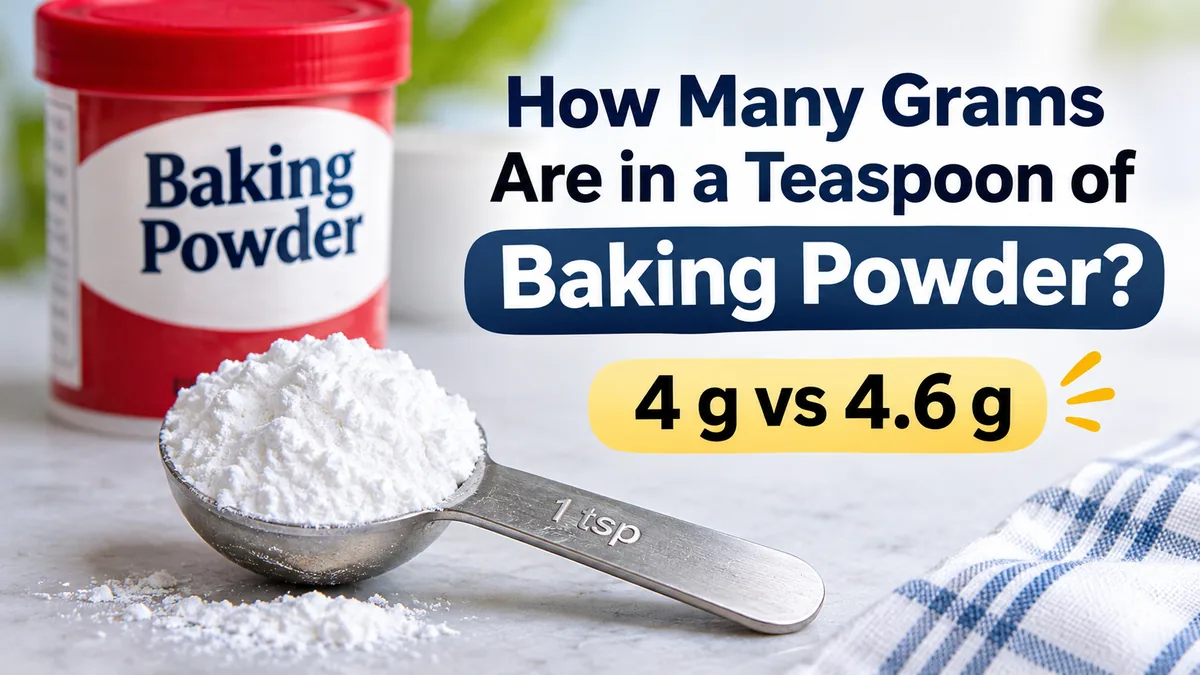
One level US teaspoon of baking powder weighs about 4 grams, according to King Arthur Baking's ingredient weight chart. Other references list a little more, so the exact figure depends on the source, the product, and how the spoon is filled.
Measuring the right amount matters when baking cakes, muffins, and other treats, because baking powder is what makes them rise. To convert a specific amount, including metric spoons, use the baking powder calculator, which also converts grams back to teaspoons.
Below, you'll find why sources disagree on the exact number, how baking powder differs from baking soda, and how to measure it accurately.
Why Sources Say 4 Grams or 4.6 Grams
Baking powder is a blend of ingredients, including baking soda, acid salts, and usually starch. Differences in the mixture and the way the powder settles can affect how much fits into a teaspoon. The amount also depends on how the spoon is filled and leveled, which is why the same volume may not always weigh exactly the same.
Published weights differ, too. King Arthur Baking's ingredient weight chart lists 1 teaspoon of baking powder at 4 grams without naming a type. USDA FoodData Central lists 4.6 grams per teaspoon in its records for two double-acting formulations: sodium aluminum sulfate and straight phosphate. Neither source says how its teaspoon was filled or leveled, so the two figures may not reflect the same product or measuring conditions. Neither should be treated as an exact weight for every brand.
The gap is about 0.6 grams per teaspoon, or roughly 15%. In a recipe that calls for 2 teaspoons, that is 8 grams by one reference and 9.2 grams by the other. For everyday baking, either works as a guide; this article uses 4 grams, the same value as our calculator. If your recipe gives a weight in grams, measure that weight rather than converting it.
The same principle explains why a teaspoon of salt, sugar, or flour weighs something different again. Learn more about why teaspoons weigh differently from one ingredient to the next.
Baking Powder vs Baking Soda — Don't Swap Them
Baking powder and baking soda may look similar, but they are different ingredients. Baking soda is sodium bicarbonate, while baking powder combines sodium bicarbonate with dry acid salts and usually starch. These differences affect how each ingredient reacts in a recipe.
They also have different weight conversions. On this site, one level US teaspoon of baking powder is listed at approximately 4 grams, while one level US teaspoon of baking soda is listed at approximately 6 grams, about 50% heavier for the same spoon. Both figures come from King Arthur Baking's ingredient weight chart.
Because the two ingredients work differently, you cannot simply replace one with the same spoonful of the other. Baking soda on its own stays quiet until the recipe gives it something acidic; baking powder brings that acid with it. Using the wrong ingredient or amount can affect a baked good's rise, texture, and taste.
If a recipe calls for baking powder, use baking powder; if it calls for baking soda, use baking soda.
Measuring Baking Powder for Consistent Results
Small amounts of baking powder can make a difference in baking. Too much or too little can affect how your cakes, muffins, and other baked goods rise.
Follow these simple steps to measure a level teaspoon:
- Break up any lumps. If the baking powder has small clumps, gently loosen them with a dry spoon before measuring.
- Use a proper measuring spoon. Choose a clean, dry measuring teaspoon rather than an ordinary eating spoon, which may hold a different amount.
- Fill the spoon without packing. Add enough baking powder to create a slight mound, but do not press it down.
- Level the top. Sweep the straight edge of a knife across the rim to remove the excess powder.
- Use smaller measuring spoons when needed. For amounts such as ⅛, ¼, or ½ teaspoon, use the matching measuring spoon instead of estimating part of a larger one.
If your recipe specifies grams, use a kitchen scale for a more consistent measurement. A scale that measures in 0.1-gram increments can be helpful when working with very small quantities.
Storage and Freshness
Keep baking powder tightly closed and store it in a cool, dry place. Clumps can be a sign that it has been exposed to moisture.
If you are unsure whether it is still active, test its freshness before using it in a recipe. King Arthur Baking's freshness test stirs ½ teaspoon of baking powder into 2 tablespoons of warm water: active baking powder should bubble and foam. If it barely reacts, replace it. An accurate measurement cannot make up for stale baking powder, because the spoon can hold the right weight and still give less lift.
Frequently Asked Questions
How many grams are in 1 tablespoon of baking powder?
One US tablespoon contains 3 teaspoons. At approximately 4 grams per teaspoon, 1 tablespoon of baking powder weighs about 12 grams.
My recipe lists baking powder in grams. How many teaspoons is that?
Divide the grams by 4, the approximate weight of one level US teaspoon. For example, 10 g ÷ 4 = 2½ teaspoons, and 6 g ÷ 4 = 1½ teaspoons. If you have a kitchen scale, weighing the amount directly is more reliable.
Is a metric teaspoon of baking powder the same as a US teaspoon?
Not exactly. A US teaspoon holds about 4.93 mL, while a metric teaspoon holds 5 mL. Using the same approximate weight relationship, a metric teaspoon of baking powder comes to about 4.06 grams. Our guide to US and metric teaspoon sizes explains the difference.
Should I measure baking powder with a level or heaping teaspoon?
Use a level teaspoon unless your recipe specifically says otherwise. A heaping spoon holds more baking powder than the standard conversion assumes, which can affect the amount added to your recipe.
Can I use baking soda instead of baking powder?
No, not in the same amount. Baking soda and baking powder have different ingredients and react differently in recipes. Baking soda needs the recipe itself to supply the acid; baking powder brings its own acid along. Use the ingredient specified in your recipe.
Is weighing baking powder more accurate than using a teaspoon?
Yes. A kitchen scale measures weight directly, while a teaspoon measures volume. The weight can change depending on the product and how the spoon is filled. If your recipe lists baking powder in grams, weighing it is the more reliable choice.
Conclusion
A level US teaspoon of baking powder weighs approximately 4 grams, while a metric teaspoon weighs about 4.06 grams. These are reference estimates, so the actual weight may vary depending on the brand and how the powder is measured.
For consistent results, use a level measuring spoon rather than packing or overfilling it. If your recipe gives the amount in grams, a kitchen scale is the more reliable choice.
Also, remember that baking powder and baking soda are different ingredients, so use the one your recipe calls for.
Need to convert another amount? Use our baking powder converter to quickly check other measurements.